

February 2026 |
Welcome to a very special edition of the WTUN Newsletter in celebration of International Day of Women and Girls in Science.
Together we have compiled stories and accounts from across the World Technology Universities Network; sharing the achievements, ambitions and successes of women researchers, staff and students from a wide-range of STEM related disciplines
Thank you to all of the contributions that made this special edition possible. We hope you enjoy reading.

Background
A significant gender gap has persisted throughout the years at all levels of science, technology, engineering and mathematics (STEM) disciplines all over the world. Even though women have made tremendous progress towards increasing their participation in higher education, they are still under-represented in these fields.
Gender equality has always been a core issue for the United Nations. Gender equality and the empowerment of women and girls will make a crucial contribution not only to economic development of the world, but to progress across all the goals and targets of the 2030 Agenda for Sustainable Development, as well. On 20 December 2013, the General Assembly adopted a resolution on science, technology and innovation for development, in which it recognized that full and equal access to and participation in science, technology and innovation for women and girls of all ages is imperative for achieving gender equality and the empowerment of women and girls.
Did you know?
- Globally, young women are more likely than young men to pursue higher education—46% enroll within five years of completing secondary school, compared with 40% of men—yet women make up only 35% of science graduates.
- Fewer than 2% of applicants for jobs in the quantum sector are women—just one in 54. Moreover, 80% of quantum companies reportedly have no senior female leaders.
- Out of thousands of scientific articles in water-related disciplines, fewer than 100 addressed both gender or women and hydrology. In 2022, nine of the top 21 hydrology journals published no articles referencing gender, while the rest published only one to 14.
source- https://www.un.org/en/observances/women-and-girls-in-science-day
The University of Applied Science Upper Austria has hosted their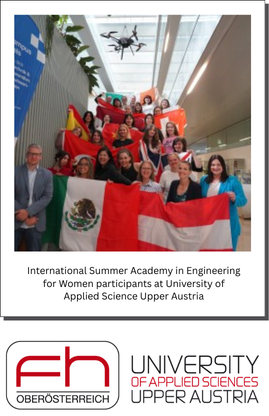 “International Summer Academy in Engineering for Women” (ISAE4W) for 12 years. ISAE4W is an initiative to foster female participation in Engineering/STEM studies.
Aimed at Female Engineering students aged 18-25, past programmes have included exclusive insights into the world of hydropower, space technology, ethical and sustainable product design, Internet of Things for astronomical observations, current projects in medical technology and robotics.
So far ISAE4W has:
👩🎓 240 graduates
🌍 50 represented countries
🏫 90+ different institutions
fh-ooe.at/en/campus-wels/international-summer-academy-in-engineering-for-women
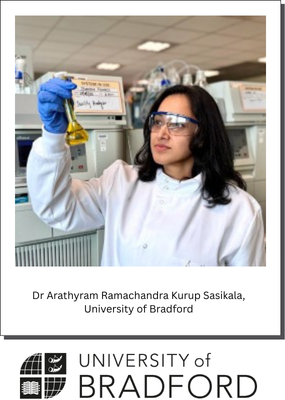 Dr Arathyram Ramachandra Kurup Sasikala, Assistant Professor in the Faculty of Health and Social Care at the University of Bradford is leading a project to develop an exciting new technology using nanotechnology with healing properties, known as ‘piezoelectroceutics’.
She was awarded £2.2 million as part of a four-year UKRI Future Leaders Fellowship to focus on bone healing – a major health challenge, especially in older people, which costs the NHS billions of pounds per year to treat.
Dr Sasikala’s previous research has included using nanoparticles for cancer treatment and smart biomedical devices, and in this case the technology is an injectable gel-based implant which can generate electrical signals without any batteries or power supply, getting the energy it needs to function from the normal movement of the body. The technology works like the body’s own healing processes that use electricity, and augments them to accelerate bone healing, meaning there is no need for surgical interventions.
Dr Sasikala will spend time with project partners in the UK and USA to learn from their specific areas of expertise, and will be organising workshops and meetings to share the ideas behind piezoelectroceutics with the goal of inspiring others to get involved with this new field of research.
Dr Pedi Obani, Associate Professor in the School of Law, was awarded Future Leaders Fellowship status in 2024 by the UK Resear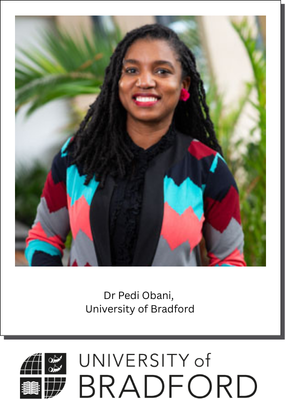 ch and Innovation (UKRI) funding body, receiving £1.28 million in funding for a four-year project to develop frameworks for gender-inclusive climate change governance through collaborative approaches.
This work addresses how women in countries affected by extreme weather caused by climate change are disproportionately affected, for example having to spend more time on tasks such as collecting water or caring for relatives; they are also mainly excluded from the decision-making process.
The research is taking place in Nigeria, South Africa and Kenya, with a base in each country including a postdoctoral researcher with local knowledge and cultural awareness gathering the experiences of women and their priorities for climate action.
This project is also exploring how women can be part of the solution in terms of equal political and legal representation. The aim is to not only highlight the demand for justice, but to create opportunities that enable female lawyers to take on and represent climate cases.
As part of the project, the University of Bradford hosted the Climate Justice for Women conference in November 2025.
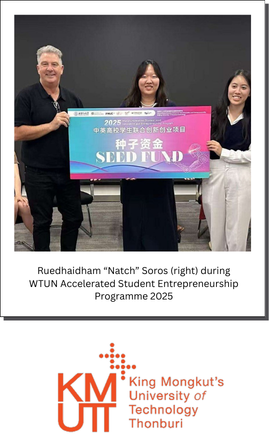
Learning, Leading, Building: Ruedhaidham Soros and the Rise of a New Generation of Women in Science
Ruedhaidham “Natch” Soros is a young technology entrepreneur whose career began long before graduation. An alumna of the International Computer Engineering Programme at King Mongkut’s University of Technology Thonburi (KMUTT), she represents a new generation of women in science who learn, build, and lead simultaneously. While pursuing a demanding engineering degree, she balanced rigorous coursework with hands-on projects, leadership roles, and early-stage startup development.
As a recipient of the Saet Lueang Rueang Rung Leadership Scholarship* and The Royal Award for Outstanding Higher Education Student, Natch developed a service-oriented leadership mindset through entrepreneurship initiatives and international programmes, including the WTUN Accelerated Student Entrepreneurship Programme in the UK and China.
During her university years, she co-founded two EdTech startups, with Eduvice receiving funding from Thailand’s Ministry of Higher Education, Science, Research and Innovation. Following support from the WTUN Accelerated Student Entrepreneurship Programme, she later co-founded PATHWAY, an internationally oriented EdTech venture connecting young people with mentors and clearer learning pathways, supported by the WTUN and the University of Bradford.
Today, Natch serves as Senior Founder’s Associate and Entrepreneur-in-Residence at SEA Bridge, a venture-building firm, while continuing as CEO and Co-Founder of Eduvice and PATHWAY.
* [Saet Lueang Rueang Rung Leadership Scholarship] “Saet Lueang Rueang Rung Leadership Scholarship” is a prestigious grant from King Mongkut’s University of Technology Thonburi (KMUTT). It is awarded to students with outstanding potential in both academics and specialized talents. The scholarship is named after the university’s official colors (Orange and Yellow).”
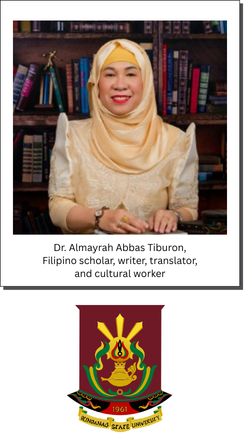 Dr. Almayrah Abbas Tiburon is a Filipino scholar, writer, translator, and cultural worker whose academic and creative work bridges research, literature, and indigenous knowledge, demonstrating how scientific inquiry in the social sciences can emerge from culture, language, and lived experience.
A faculty member of the Department of Filipino and Other Languages at Mindanao State University and Director of the MSU Sentro ng Wika at Kultura, her scholarship foregrounds Meranaw culture, women’s narratives, and the intersections of war, peace, and identity as critical sites of knowledge production. Her research includes studies on women’s strength amid social adversity, parenting practices in literature, supremacist ideology in contemporary poetry, and policy analysis for Lake Lanao, reflecting an interdisciplinary approach that connects literary studies, social science research, and community-based knowledge.
Alongside academic research, Dr. Tiburon has authored and edited award-winning books, many recognized by the National Book Awards and featured by CNN Philippines, the Cultural Center of the Philippines, and international literary journals. A two-time recipient of the Gawad Ongangen and a national “Kampeon ng Wika 2024” awardee of the Komisyon ng Wikang Filipino, she was also named among the “10 Noteworthy Filipina Writers” by Spot.ph. Through research, teaching, and writing, Dr. Tiburon advances the visibility of Meranaw knowledge systems and affirms women’s voices—especially those of women and girls—as essential to science, scholarship, and social transformation.
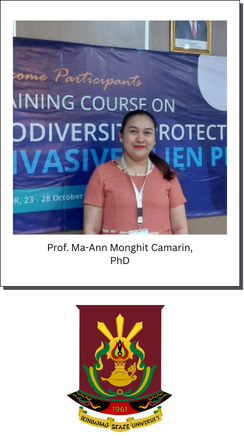 Prof. Ma-Ann Monghit Camarin, PhD, stands out as a dedicated and accomplished woman scientist making significant strides in the field of fisheries and aquatic sciences. With a Ph.D. from the University of the Philippines and a strong academic background maternal to her leadership role as College Dean at Mindanao State University, she has continually advanced knowledge in aquaculture, water quality, and microbiota research.
Her pioneering work on biofloc technology has contributed to sustainable aquaculture practices, addressing vital concerns about environmental impact and food safety.
As an active researcher with numerous publications and ongoing projects, she has earned recognition through prestigious scholarships and research grants, including those from the International Foundation for Science and the Department of Science and Technology. Her commitment extends beyond research, she serves in professional organizations like the Asian Fisheries Society, advocating for innovation and sustainability.
Dr. Camarin’s achievements exemplify how women in science can lead transformative change, inspiring future generations to pursue excellence in pursuit of global food security and environmental stewardship.
 Galey Mae L. Dela Torre, a third-year BS Biology student of Mindanao State University exemplifies the strength and promise of young women in science. In 2025, she represented MSU and the Biology Department at the United Nations Sustainable Development Goals (SDG) Youth Convergence in Puerto Princesa City, Palawan, held during the 10th anniversary of the UN SDGs.
As an awardee of the Global Youth Mobilization – Youth Empowerment Fund, Galey presented her project “Panagtagbo sa Kinaiyahan: Youth and Indigenous Action for Climate Resilience,” which highlights the integration of scientific inquiry, indigenous knowledge, and community-based climate action. Beyond her scientific engagement, Galey is also a photojournalist of the Mindanao Varsitarian, where her photographs have been widely used to document significant events in MSU, amplifying student voices and institutional milestones through visual storytelling.
Her dual role as a scientist and communicator underscores the importance of making science visible, accessible, and meaningful.
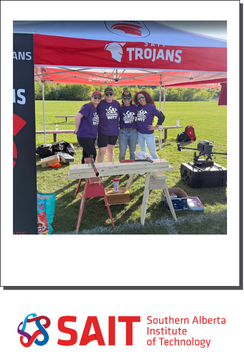 Beyond the First Flight
The moment three women stepped into instructor roles for heavy-lift, long-range drones in Canada marked a shift—but it was never meant to be the destination. At CIRUS, that milestone became the foundation for what continues to grow.
Today, female drone operators and instructors at CIRUS are deeply embedded in daily operations, research support, and advanced training. Our work spans mission design, flight instruction, safety-critical decision-making, and the integration of drone data into environmental and applied research. What was once considered exceptional has become operational reality.
Equally important is how this work extends beyond the flight line. Through mentoring students, participating in Girls in Aviation Day, and contributing to women in trades and technology initiatives, we actively sustain the pathway that milestone opened. Visibility is reinforced through action—by teaching, leading, and showing up consistently in technical spaces.
Being first mattered. Continuing to lead, train, and expand opportunities are what defines the work now. At CIRUS, women are not entering the field temporarily—we are shaping its present and future.
Read more about Stephanie Lapointe (BGIS ’17), Sara Ashoori (BGIS ’20), and Bryanna Paquette (Pro Remotely Piloted AC System ’21):
www.sait.ca/link/stories/2023/05/sait-grads-take-careers-to-new-heights
 From Physics to AI: Professor Sufen Chen Inspires Women in Science.
Sufen Chen, Chair Professor of the Graduate Institute of Digital Learning and Education at Taiwan Tech, was honored with the 2025 Future Tech Award for her innovative research in educational technology. Together with Professors Hou-Chiang Tseng and Kuan-Yu Chen, she developed the Intelligent Oral Expression Assistance System, an AI-driven platform that gives students real-time, personalized feedback on presentations.
By evaluating content, speech rate, omissions, and emotional expression, the system allows students to practice independently, strengthen communication skills, and prepare for professional and intercultural settings. Featured at this year’s Education Technology Exhibition, it highlights how AI can cultivate future-ready talent. A passionate advocate for women in STEM, Prof. Chen founded the Society of Women Engineers in 2023, creating a community to support and inspire female engineers and researchers.
Originally trained in natural sciences, she earned her BS and MS in physics from National Taiwan University before shifting her focus to education, completing a PhD in science education at Indiana University–Bloomington. Her research spans science education, technology-enhanced learning, metacognition, achievement emotions, and social media.
 Professor Pei-Jun Lee’s Award-Winning Research in Sparse Neural Network Acceleration
Professor Pei-Jun Lee of the Department of Electronic and Computer Engineering at Taiwan Tech has long focused on a central challenge in artificial intelligence: how to deliver high performance while drastically reducing energy consumption in power-constrained environments. Her latest research provides a decisive answer—and has earned her team the Taiwan Future Tech Award.
Leading a research team at her Video Signal Processing and Application Lab, Professor Lee developed a high-area-efficiency, low-voltage sparse neural network accelerator designed for edge computing. The key innovation is a two-stage pruning technique that compresses model parameters to just 0.47% of their original size, significantly reducing data and memory requirements while preserving performance. The accelerator operates reliably at 0.65V and 400MHz, achieving 10–40% higher energy efficiency than comparable architectures and reducing overall chip power consumption by 30%, extending system endurance by approximately 10%.
These capabilities make the technology particularly well suited for low Earth orbit satellites, unmanned aerial vehicles, and other power-limited platforms, as well as applications in smart agriculture, environmental monitoring, national defense, and disaster early warning. Since joining Taiwan Tech in 2008, Professor Lee has established an internationally recognized research profile in wireless communication, embedded systems, and signal processing, advancing the future of efficient edge and space technologies.
 Memory and Craftsmanship: Taiwan–Indonesia Student Team Wins at Asia-Pacific Red Dot Awards
Two Taiwan Tech design students have captured top honors at the Asia-Pacific Red Dot Awards—often hailed as the “Oscars of the design world.” LAI Yi-Hui (Indonesia) and HSIAO Chung-Wen (Taiwan) received the Best of the Best award in the Design Concept category for their book project Memory and Craftsmanship.
The project examines the traditional art of natural mud dyeing through three lenses: the memory of the land, the spirit of craftsmanship, and the transmission of skills. Organized into five color-themed chapters—gray, indigo, cinnabar, persimmon, and brown—the book weaves together patterns, dyeing techniques, and contemporary applications. Its hand-dyed mud-fabric cover preserves natural folds and textures, transforming the book itself into a tactile record of a fading craft.
By digging deep and returning to the fundamentals of the craft, LAI and HSIAO trained with master artisans and took part in every step of the process—from dyeing and drying to unfolding the fabric. LAI shared, “Coming from Indonesia, with its rich batik tradition, this project was a rare and meaningful opportunity to learn deeply about Taiwanese culture—and I’m proud to help preserve this traditional craft.”
 Red Dot Award–Winning Project Lume: Taiwan Tech Students Reimagine Funeral Design
Taiwan Tech design students You-Hsi LIU and Hung-Ling CHEN have received a Red Dot Design Concept Award for their project Lume, which rethinks how contemporary funeral rituals can be both meaningful and sustainable.
In Lume, LIU and CHEN transform the floral seas and wreaths traditionally seen at funerals into a memorial installation. Using a modular design approach, the project integrates lighting and floral elements that can be rearranged and reused, significantly reducing waste. Sustainability is central to the concept, while the design focuses on helping families form a more personal and reflective farewell. In doing so, Lume points toward new possibilities for the future of funeral practices in Taiwan.
During the development process, the students became aware of Taiwanese society’s reluctance to openly discuss death—an insight that further strengthened their commitment to the project. “We are deeply grateful to the funeral service providers, our professors, and everyone we interviewed for their guidance,” they shared. “We are very happy about the award, which encourages us to explore new ways of commemorating life through funeral rituals.”
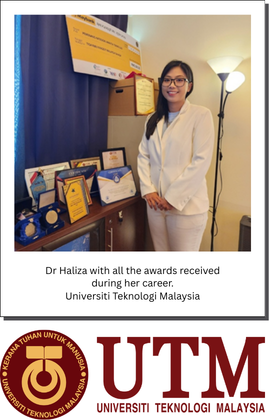 The journey of Ts. Dr. Nur Haliza Abdul Wahab illustrates the profound impact of science when driven by vision and purpose. As the Head of the Pervasive Computing Research Group (PCRG) at Universiti Teknologi Malaysia, she leads research in Blockchain, Artificial Intelligence, Quantum Computing, the Internet of Things, and Augmented Reality. Her efforts align with Industry 4.0 and Malaysia’s digital transformation agenda. Securing over RM2.7 million in research funding and overseeing numerous high-impact projects, Dr. Nur Haliza exemplifies strategic scientific leadership.
Beyond the laboratory, her influence is significant. As a Subject Matter Expert for the National Blockchain and Artificial Intelligence Committee under MOSTI, she connects academic research with policy and real-world applications. Her consultancy roles with government and industry further bridge this gap. Central to her mission is mentorship, fostering confidence, curiosity, and resilience among doctoral and master’s researchers.
Nur Haliza’s contributions to technology and society earned her the Ibu Zain Award 2025 in Technology, celebrating women making significant impacts. Balancing roles as an academic, researcher, and mother, she embodies inclusive leadership while maintaining scientific integrity. Her story underscores that science encompasses innovation, discovery, leadership, creativity, and paving the way for others to succeed.
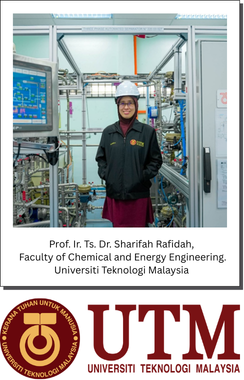 From a Young Visionary to a Pioneer in Engineering 🧪✨
Meet Prof. Ir. Ts. Dr. Sharifah Rafidah from the Faculty of Chemical and Energy Engineering. She is a true trailblazer who proved that engineering isn’t just a man’s world. At age 30, she became a pioneer Professional Engineer at UTM, showing everyone that skill and determination matter far more than gender.
For Prof. Sharifah, STEM is more than just a job; it is a lifelong journey of discovery. She loves the challenge of fixing real-world problems, from managing energy to protecting our environment. Today, she has moved from breaking stereotypes to mentoring the next generation of women engineers.
Her advice for the future? Don’t just look for shortcuts. In a world full of AI, she believes the real value lies in thinking for yourself and truly understanding how things work. She even walks the talk by recently getting certified as an Energy Auditor just to stay sharp and relevant.
Her message to young women is simple: get your qualifications, stay curious, and use your talents to help society. By closing the gender gap and aiming for excellence, women don’t just adapt to the future, they shape it.
Happy International Day of Women and Girls in Science!
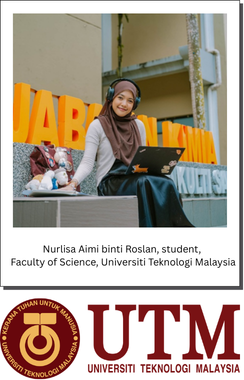
From Vision to Impact: Redefining STEM 🧪✨
Meet Nurlisa Aimi binti Roslan from the Faculty of Science. As a student navigating the world of STEM, she believes that true mastery goes far beyond just getting good grades. For Nurlisa, the real challenge isn’t memorizing facts, but truly understanding the “why” behind the knowledge.
What keeps her going during the tough times? It is a deep sense of gratitude. She sees her education as a privilege and finds strength in the realization that many others dream of having the same opportunity. This hunger for success and her grateful heart are what keep her moving forward whenever things get difficult.
Her vision for the next generation is all about balance. While technology is everywhere, Nurlisa encourages her peers to rely less on AI and instead seek a broader spectrum of knowledge. She believes that the best lessons aren’t always written in ink; they are often found through real-life experiences and the connections we make with others.
By staying grounded and curious, students like Nurlisa are proving that the future of STEM is in good hands.
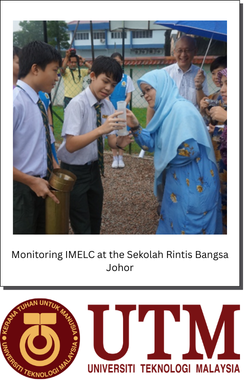 Prof. Fatin Aliah: Shaping Inclusive STEM Education
Prof. Dr. Fatin Aliah Phang Abdullah a Professor at the School of Education, Faculty of Social Sciences and Humanities, Universiti Teknologi Malaysia, she is also a Fellow at the Centre for Engineering Education (CEE).
Prof. Fatin Aliah is a pioneer in education, viewing it as a tool for systemic change rather than just knowledge transfer. As a Professor at the School of Education, Faculty of Social Sciences and Humanities at Universiti Teknologi Malaysia, and a Fellow at the Centre for Engineering Education, she actively influences how STEM is taught and perceived within educational systems.
Her research covers Physics, Engineering, STEM, and Environmental Education, fields essential for national growth and sustainability. What sets her work apart is its practical application. Prof. Fatin Aliah plays a crucial role in enhancing the STEM framework for the Sekolah Rintis Bangsa Johor initiative. Her efforts focus on curriculum design, innovative teaching methods, and teacher training, ensuring STEM education is robust, relevant, and future-ready from the school level onwards.
In 2025, she was elected as a Fellow of the Academy of Sciences Malaysia, recognising her sustained contributions to science and education. Beyond accolades, she is a strong advocate for increasing women’s participation in STEM, tackling structural barriers through research, mentorship, and leadership. Prof. Fatin Aliah excels at linking evidence, policy, and practice, crafting an inclusive and future-ready STEM education landscape.
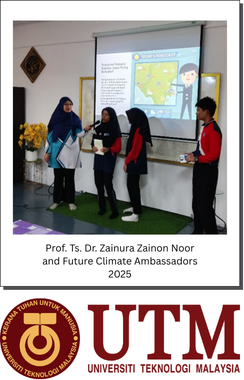 Prof. Ts. Dr. Zainura Zainon Noor leads climate and water solutions through science, public policy, and global leadership.
Prof. Ts. Dr. Zainura Zainon Noor, FASc is a nationally and internationally recognised environmental scientist specialising in environmental sustainability, water security, and green technology. With more than two decades of experience, she currently serves as the Director of the Centre for Environmental Sustainability and Water Security (IPASA) at Universiti Teknologi Malaysia (UTM), leading interdisciplinary research on climate resilience, sustainable water systems, and environmental governance.
A Fellow of the Academy of Sciences Malaysia (ASM), Prof. Zainura is the Chair of the ASM Environment Committee, providing science-based leadership to support national policy development on environmental sustainability and planetary health. She also serves as the Environment Working Group Chair for Science Outlook 2025, contributing strategic foresight and evidence-based assessments to strengthen Malaysia’s science, technology, and innovation agenda, and is actively involved in the Water Sector Transformation 2040 (AIR 2040) initiative.
In governance, Prof. Zainura is a Commissioner of the National Water Services Commission (SPAN) and Chair of the SPAN Technical Committee, contributing scientific expertise to the regulation of Malaysia’s water and sewerage sector. Internationally, she is an ASEAN–U.S. Science and Technology Fellow and a co-investigator of the UKRI Global Challenges Research Fund Water Security Hub.
Her commitment to education, mentoring young researchers, and climate education for schools reflects the vital role of women in science in shaping a more sustainable and resilient future.
Happy International Day of Women and Girls in Science
2026

Do you know someone in your university who would be interested in this newsletter? Forward the email to colleagues or share the link with your networks.
All members are invited to contribute to this newsletter through their Operational Board Member (found here). Please contact your Operational Board member with stories or events which will be of relevance to the shared vision and commitments of the WTUN and its members, inspiring opportunity for engagement on commonalities, sharing knowledge, or collaboration.
All calls for content can be shared with the WTUN Secretariat at wtun@bradford.ac.uk.
To discuss joining the World Technology Universities Network, please contact the WTUN Development Manager:
Denise Whitehead
Email: wtun@bradford.ac.uk