Tag: MemberNews

WTUN Collaborates with ATU-Net for World Engineering Day 2023

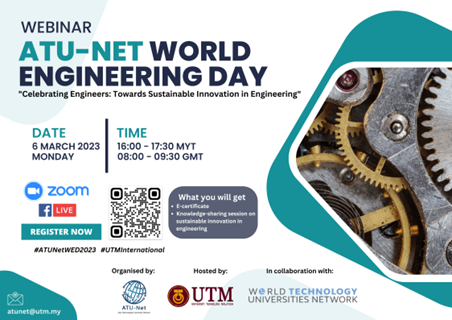
The World Technology Universities Network is pleased to collaborate with Asia Technological University Network (ATU-Net) for ATU-Net World Engineering Day 2023 (ATU-Net WED 2023)

Hosted by Universiti Teknologi Malaysia (UTM), ATU-Net WED 2023 highlights the theme “Celebrating Engineers: Towards Sustainable Innovation in Engineering”, which will feature a sharing session by prominent speakers of member universities from both Networks.


Details of the programme are as follows:

Date: 6 March 2023 (Monday)
Time: 16:00 – 17:30 (UTC+8) / 08:00 – 09:30 (UTC+0)
Mode: Virtual on Zoom and Facebook Live (ATU-Net)
Fee: Free of Charge
Registration Link: https://forms.gle/T43XYNwxjCDPE5PR9
Registration Deadline: 3rd March 2023 (Friday)
Website: https://atunet.org/atunetwed2023/

ATU-Net WED 2023 is designed in conjunction with the World Engineering Day for Sustainable Development which is celebrated every 4th March beginning in 2020, proclaimed by UNESCO at its 40th General Conference in 2019. As an international alliance which focuses on Engineering and Technology, ATU-Net takes pride in recognising and honouring the valuable contribution of all excellent engineers of ATU-Net member institutions and beyond in advocating sustainable innovation in engineering for our next generation.

Participants of this event will be provided with an e-certificate at the end of the programme.

Should you have any further enquiries, please do not hesitate to contact the secretariat at atunet@utm.my.

For details of upcoming all WTUN Webinars click here 

Two new members join the World Technology Universities Network

The World Technology Universities Network are pleased to announce two universities from Oman and Thailand have officially joined the Network.

The new members are Majan University College, Oman and Thaksin University, Thailand. 

Majan University College was established in 1995 as the first private sector College in Oman, and has continued to be at the forefront of higher education in the Sultanate ever since. In December 2017, Majan achieved full institutional accreditation from the Oman Authority for  Academic Accreditation and Quality Assurance of Education (OAAAQA), and maintained its reputation as a trailblazer by being the first higher education institution in the country to do so. 

“In light of 21st century challenges, technology and innovation are central to Oman’s Vision 2040 and MUC is delighted to have the opportunity to engage productively with universities across the world through the WTUN network to help in its efforts to support this vision. Data science and cybersecurity are growth areas for our research and we look forward to engaging with other members in these areas in particular” Dr Maha Kobeil, Dean and CEO, Mahan University College

Thaksin University was one of the first higher education institutes in the south of Thailand, initially called the College of Education, initiated by the Ministry of Education. This college replaced the High Teacher Training at Prasarnmitra Road, Phrakhanong District, Phranakorn, in 1954. It was established under the goals to develop a philosophy and modern educational concepts in association with a democratic society, including the in-depth development of education as a systematic career, respectively, to provide a degree in education. Thaksin University logo. Blue and grey on white background

Unfortunately, colleagues from MUC were unable to join us in-person at WTUC2022 in Thailand.


WTUN members in the press- New Postgraduate Research Training Programmes (PRTPS) at ATU

PROFESSOR PHILIP NOLAN LAUNCHES NEW POSTGRADUATE RESEARCH TRAINING PROGRAMMES (PRTPS) AT ATLANTIC TECHNOLOGICAL UNIVERSITY

PRTPS will produce multi-disciplinary research graduates in two key growth areas – Modelling and Computation for Health and Society (MOCHAS) and Operations and Supply Chain Research (OSCAR).

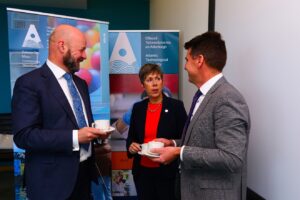
Director General of Science Foundation Ireland (SFI) and former chair of the National Public Health Emergency Team (NPHET)’s Irish Epidemiological Modelling Advisory Group Professor Philip Nolan officially launched Atlantic Technological University’s new Postgraduate Research Training Programmes (PRTPs) today, Wednesday 28 September, at the ATU Galway campus.

The first two new programmes aim to produce high-level multi-disciplinary research graduates in Modelling and Computation for Health and Society (MOCHAS) and Operations and Supply Chain Research (OSCAR), with 30 scholarships funded in the initial awards. A cohort of PhD scholarships are provided under each programme focused around addressing specific societal and industry challenges.

ATU is establishing these Postgraduate Research Training Programmes in collaboration with external partners in industry and academia. This will equip PRTP graduates with the technical, field-specific skills and transferable skills required to achieve employment in high-value jobs and to adapt to rapidly evolving workplaces. Students joining the programmes will have access to learning environments of research excellence across the campuses of ATU which span the west and north-west of Ireland.

Professor Philip Nolan, Director General, SFI, congratulated ATU on these initiatives: “Science Foundation Ireland is delighted to support the Technological Universities as they continue to build excellence and capacity in research and innovation. That development is very evident today. Atlantic Technological University have demonstrated great initiative and ambition in the design and implementation of their Postgraduate Research Training Programmes.

“ATU’s implementation of PRTPs is informed by international and national developments in relation to doctoral training; industrial and work-based learning; and transferable research skill development. The PRTPs involve designed collaboration between Higher Educational Institutions, private and public enterprises, agencies, and Non-Government Organisations (NGOs). This is likely to accelerate the generation of relevant research outcomes and to ensure that these outcomes are adopted and impactful.

“I congratulate ATU for their acute focus on societal challenge, research impact and student opportunity. This approach augurs well for further collaboration between ATU and the SFI Research Centres and Programmes. I wish the Programme teams and PhD Scholars involved in the MOCHAS and OSCAR PRTPs every success.”

Dr Rick Officer, Vice-President for Research and Innovation at ATU Galway-Mayo said the launch is a proud day for ATU as it continues to expand its research activities: “Our Postgraduate Research Training Programmes represent a novel and ambitious initiative for our new university. PRTPs will help to shape the future postgraduate research environment within ATU, and to deliver on our vision for research across key strategic areas critical to our region.

“The two programmes being launched today focus on key challenges of great societal and sectoral importance: operation and supply chain improvement, and the application of computational technologies in medical-care and healthcare.

“In congratulating the teams behind these two programmes I also want to recognise the leaders of our other candidate PRTPs. An independent and international evaluation recognised excellence in eight PRTP proposals and recommended another six PRTPs for funding.”

These two programmes were selected through a competitive application process that was independently and internationally reviewed. Each programme is recruiting a cohort of 15 PhD students who will conduct individual 4-year research programmes in collaboration with partners in higher education, public and private enterprise, government agencies, and non-governmental organisations.

Atlantic Technological University

The World Technology Universities Network welcomes its newest members

The Shibaura Institute of Technology (SIT), in Japan and the University of Applied Sciences Upper Austria (FH Upper Austria), are the latest institutions to join the World Technologies University Network (WTUN).

They join Koforidua Technical University, in Ghana, which also joined WTUN during 2019, to form a thriving network of 25 technology-focused institutions from every continent. Each member is committed to working collectively and collaboratively to develop pragmatic and sustainable solutions to global challenges.

In particular, both SIT and FH Upper Austria are firmly focused on the benefits of international networking to provide the best-possible opportunities for students as well as delivering world class research.

Benefits to WTUN membership include opportunities to take part in exchanges and collaborative research, as well as making links between institutions, industry, NGOs and SMEs. Our annual congress, hosted by one of the member institutions, offers valuable opportunities to keep up-to-date with WTUN activities and acts as a springboard for new collaborations.

Professor Brian Cantor, Chair of WTUN, said: “We’re delighted to welcome these three new members to the WTUN network. Each of them will bring distinctive strengths that will enable us to pursue our overall aims of bringing together the collective technology research power of our members to address some of the worlds most complex and systemic challenges.”

Shibaura Institute of Technology, in Japan, is one of the country’s top global universities, focusing on  nurturing practical engineers to lead Japan’s industrial development. Founded in 1927, SIT has three campuses, two in Tokyo, and one in Saitama, about 30 km to the north of the capital. The Institute’s philosophy of ‘learning through practice’ informs teaching and research across its four faculty with a firm emphasis on developing competent, skilled and creative individuals capable of making a sustainable contribution to society.

Shibaura’s president, Professor Masato Murakami, “WTUN draws together like-minded institutions with an emphasis on global exchange programmes and partnerships. As well as opening up opportunities for students, we hope that, through our membership of WTUN, we will be able to extend our research capabilities – this is key for increasing our ranking both globally and regionally. We’re also very pleased that SIT’s emphasis on gender equality is also a priority for the WTUN and we’re looking forward to joining with WTUN’s initiatives in this important area.”

The University of Applied Sciences Upper Austria (FH Upper Austria) is the country’s strongest university of applied sciences in terms of research. It has 6,000 students studying at campuses in Hagenberg, Linz, Steyr and Wels and brings in research grants worth around €20M per year. The university’s strengths in technology, including AI, energy and renewable energy, medical engineering and food technology, make it an important partner for companies both in Austria and neighbouring countries.

The University also has a strong focus on international collaboration, fostering a large network of around 250 partners across all five continents. Membership of the WTUN will enable the University to further strengthen its collaborations in technology and engineering research.

Dr. Günther Hendorfer, co-ordinating WTUN activities at FH Upper Austria, said:  “We’re very much looking forward to engaging in joint research programmes across all of our areas of research expertise. We’re also keen to invite WTUN specialists to come and talk to our students in our new PhD college that is currently under construction and to taking part in the WTUN Student Competition.

“A priority for FH Upper Austria is to ensure that we have sufficient qualified engineers – intiatives such as WTUN could be really valuable in developing a common approach to bringing new young people into the field of engineering.“

© World Technology Universities Network 2026